
A window replacement is a structural decision. You swap leaky sashes, tired glazing, and frames that have given up on the marine air. When the crew leaves, the room looks brighter and the envelope is tighter. That is the job the glass was hired to do. It is not the whole job of living with a San Diego window.
The coast still throws hard light across living rooms in the late afternoon. Patio doors still dump heat onto tile. Bathrooms still need privacy without turning the space into a cave. Street noise still finds the same opening it always did. Interior plantation shutters are the finish layer that new glass cannot supply on its own: a movable, room-by-room way to tune air, light, and sound after the replacement windows are in.
What new glass actually solves
Replacement windows earn their keep at the perimeter. Better frames reduce drafts. Modern insulated glass slows the transfer of heat. Operable hardware that still latches makes a bedroom safer and a kitchen less rattly in a Santa Ana. Those gains show up on utility bills and in the feel of a room at 7 a.m. They do not, by themselves, give you a way to cut the western glare on a television, keep a sunroom from cooking in August, or hide a bathtub from the sidewalk.
Homeowners sometimes treat the covering as an afterthought, as if any leftover blinds from the old openings will sit on the new ones. That rarely works. The opening has changed. The light path has changed. The reason you spent money on the glass — comfort, not just a prettier frame — is unfinished until the interior side of the window can be adjusted without fighting the new product.
Coastal light is a control problem
San Diego light is not the soft, overcast light of a northern winter. It is low, bright, and often bouncing off stucco, water, and pale concrete. After a replacement, that light comes through cleaner glass. The view improves. So does the glare. A living room that faced west before the project will face west after it. The difference is that the new unit may admit the same solar geometry with less haze and fewer leaks, which can make the glare feel sharper rather than milder.
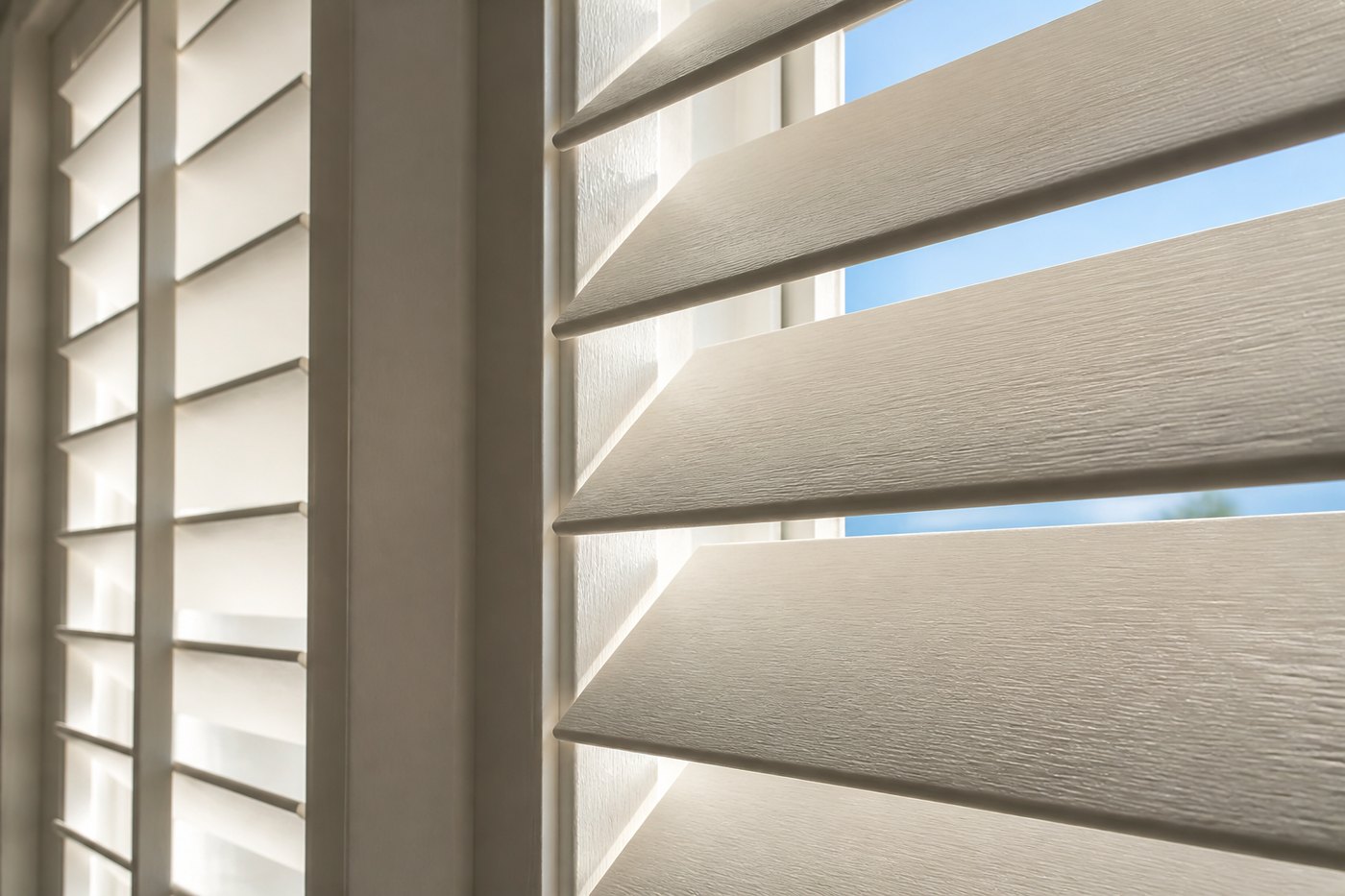
Plantation-style interior shutters give you a louver you can tilt by hand. Closed, they present a solid plane. Cracked open, they throw a band of light across a floor without washing out a seating area. Fully open, they disappear into the frame and leave the new window to do what it was bought to do: show the garden, the canyon, or the street trees. That is a different tool from a roller shade that is either up or down, or a drape that collects dust in a marine climate.
The same geometry matters on a patio door and in a sunroom. Those rooms exist because of glass. They fail when the glass has no interior partner. A shutter panel can be hinged or bi-folded so the door still operates. The point is not to hide the replacement. It is to keep using it through the brightest hours of a coastal day.
Heat after the install is still a room problem
New windows reduce unwanted heat flow. They do not cancel the sun. A south kitchen still takes a load at lunch. A dining room that opens to a patio still warms when the slider is shut. Interior shutters add a layer of still air and a surface you can close when the room is empty. That is not a substitute for a good window. It is why the good window remains comfortable at 4 p.m.
Material choice follows the room, not a catalog mood board. Vinyl shutters with a honeycombed core are the practical spec for high-moisture spaces — bathrooms, laundry rooms, a kitchen that sees steam. Polyclad shutters, a rigid polyvinyl surface clad over hardwood, are the premier plantation-style product for living rooms and dining rooms where the panel will be handled every day. Basswood, kiln-dried and milled with a beaded groove at the stiles and rails, is the wood option when the interior is meant to read as furniture rather than as a plastic plane. None of those choices should be made before the replacement glass is specified, but none of them should wait until the first heat wave after the punch list.
Street noise and the second leaf
Glass thickness and frame quality do most of the acoustic work. A second, close interior leaf still helps, especially on rooms that face a collector street, a school pickup line, or a flight path. Shutters do not turn a house into a recording studio. They do give you a dense, hinged panel that can be closed at night in a bedroom or during homework hours in a dining room. Combined with a well-fitted replacement window, that is often the difference between “we can hear the street” and “we notice it only when the louvers are open.”
This is the stage of a project where a local manufacturer is more useful than a big-box covering. Shuttermart in San Diego has been a family-owned shutter maker since 1950, building vinyl, polyclad, and basswood interiors locally rather than importing a one-size panel and forcing it onto a new opening. Free design consultations are part of that process. Most orders run six to eight weeks, which is long enough that the shutter conversation should start while the window order is still in production, not after the last piece of trim is caulked.
Rooms that need a finish layer
Not every opening wants the same treatment. A bathroom needs moisture-tolerant construction and privacy that does not depend on a fabric panel. Vinyl, honeycombed, is built for that. A living room wants the wide-louver look people mean when they say plantation shutters; polyclad is the product sold for that job, with a surface that is described as resistant to scratch, dent, fade, and peel, and that does not need paint. A kitchen or dining room has to survive grease, wipe-downs, and kids. A sunroom and a patio opening have to manage more light than a north bedroom. Basswood belongs where the millwork is meant to match other wood in the house.
The Hotel del Coronado is a useful reminder that custom interior shutters are not only a suburban living-room product. Shuttermart designed and built custom shutters for nearly 100 of the hotel’s guest rooms, a hospitality job that had to respect a historic property and still give guests control of light and privacy. A house after window replacement is a smaller version of the same problem: new glass, old architecture, and a need for an interior that can be adjusted room by room.
Install timing, not a measuring lecture
You can hang the panels yourself as a weekend project, or you can have professional installers do it in as little as a day once the order arrives. Either path assumes the openings are finished. That means the replacement windows are in, the interior casing is on, and you are no longer guessing at drywall returns. Measuring is a separate skill, and this site already covers it. The decision that belongs here is sequence. If the glass is eight weeks out and the shutters are six to eight weeks out, the two calendars should overlap. If you wait until the windows look naked, you will live with glare and heat for the better part of two months.
A design consult is the way to lock that sequence and to decide, opening by opening, whether vinyl, polyclad, or basswood belongs in a bathroom, a living room, or a sunroom. The shop is at 9825 Carroll Centre Rd, Suite 400, San Diego, CA 92126, phone 1-619-276-6722. That is a Mira Mesa address, not a warehouse in another state.
The bottom line
Window replacement in San Diego fixes the glass. Interior plantation shutters finish the room. They cut coastal glare, hold heat at the opening, and add a second leaf against street noise without covering the windows you just bought. Vinyl, polyclad, and basswood are different tools for different rooms. Start the interior conversation while the replacement order is still in the queue.