
Getting the right fit for your interior shutters starts long before you pick a louver size or choose a finish — it starts with accurate measurements. If you’re planning to upgrade your San Diego home with custom plantation shutters, knowing how to measure windows for interior shutters can mean the difference between a flawless install and a costly mistake. At Shuttermart, we’ve been helping San Diego homeowners get this right for over 70 years, and we know exactly where things go wrong — and how to prevent it.
Custom interior shutters are made to order. Unlike off-the-shelf blinds, there’s no easy return if a shutter doesn’t fit. Once your order is submitted and manufacturing begins — a process that typically takes 6 to 8 weeks — your dimensions are locked in. This guide covers what every homeowner should understand before placing an order: the right mount type for your windows, the three dimensions that determine your shutter size, the mistakes that most commonly derail a good install, and when it’s worth calling in a professional measurer instead of going DIY.
Why Accurate Window Measurements Are the Foundation of a Perfect Shutter Install
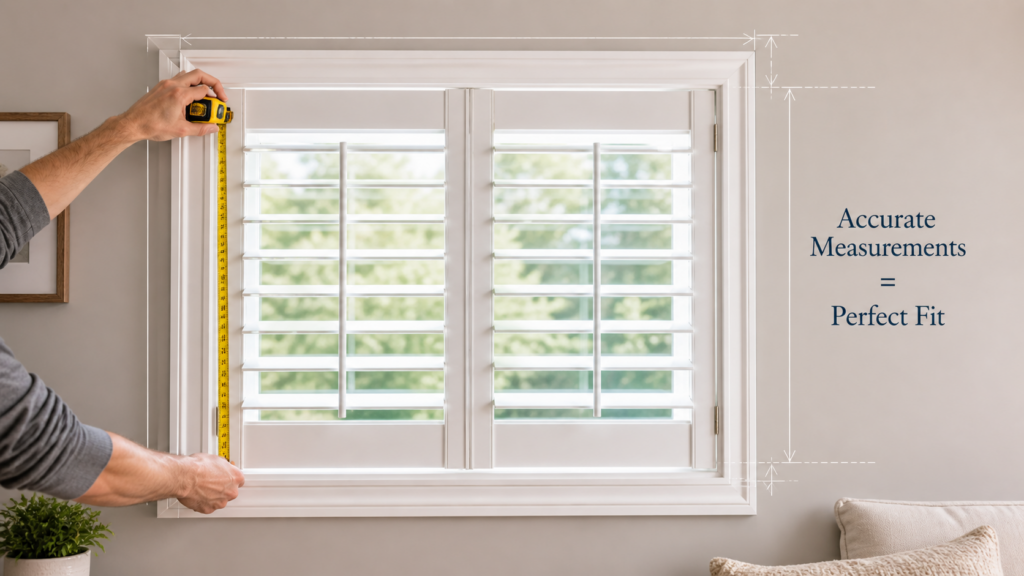
Interior shutters are a permanent, custom-built product. A measurement that’s off by even a quarter of an inch can result in shutters that bind in the frame, leave visible gaps along the edges, or won’t close properly. In our experience at Shuttermart, the majority of shutter problems we’re asked to troubleshoot don’t trace back to material quality or installation technique — they trace back to inaccurate initial measurements.
San Diego homes add an extra layer of complexity here. Properties in older neighborhoods like Mission Hills, North Park, and Hillcrest often have window frames that have shifted over the years due to the region’s expansive clay soils and decades of dry-season settling. What looks like a perfectly square window opening may not be square at all once you measure it corner to corner. Even newer construction in Carlsbad or Rancho Bernardo can show surprising variation between the top and bottom of a window frame.
Precise measurement also drives decisions about panel configuration, louver size options, and which frame style works best for a given opening. Get it right at the start and everything downstream — ordering, manufacturing, and installation — goes smoothly.
Inside Mount vs. Outside Mount: Which Installation Method Is Right for Your Home?
Before picking up a tape measure, you need to decide whether your shutters will be inside mounted or outside mounted. This single decision changes how every dimension is recorded and how your final measurements are used.
Inside mount shutters sit within the window recess, flush with the surrounding wall. They create a clean, architectural look that’s especially popular in San Diego homes — the finished result looks as though the shutters were designed into the home from the start. Inside mount works best when your window frame is square and offers enough depth to accommodate the shutter panel and mounting hardware, generally at least 2.5 inches of clear space from the front of the frame to the back wall or glass.
Outside mount shutters attach to the wall surface or window casing, covering the window opening from the exterior face of the frame. This is the better choice when:
- Your window recess is too shallow for inside installation
- Your frames are significantly out of square or show structural irregularities
- Window handles, latches, or hardware obstruct the recess
- You want to visually enlarge the window by mounting wider than the actual opening
Outside mount is particularly useful in bathrooms and kitchens where moisture-resistant vinyl shutters need to clear a deep sill, or in older homes where decades of settling have left window frames too warped to support a clean inside installation.
The Three Measurements That Determine Your Shutter Size
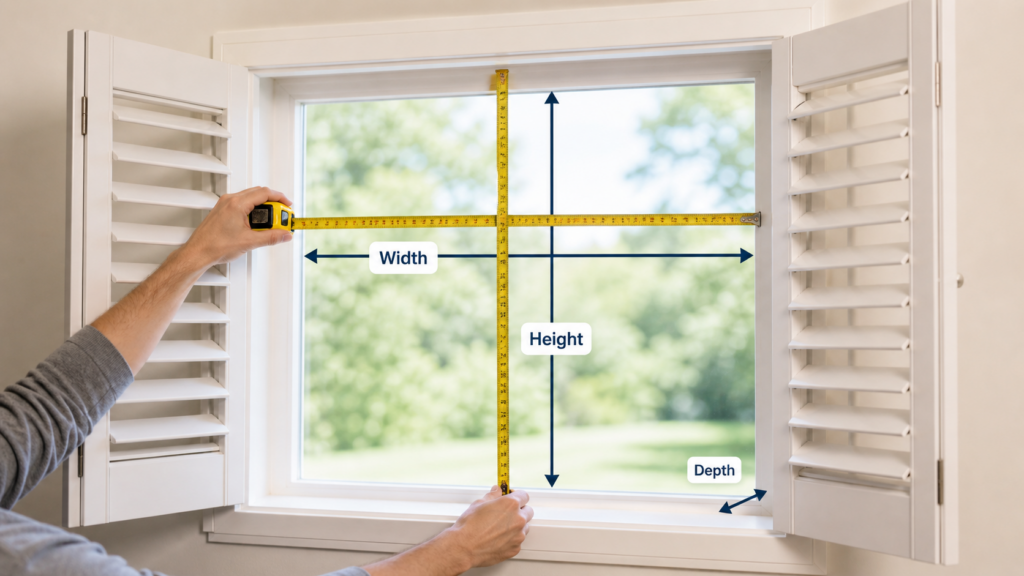
Every custom shutter order is built around three core dimensions: width, height, and depth. Each one must be taken at multiple points — because no window is perfectly uniform from edge to edge.
Width: Always Measure at Three Points
Measure the width of your window opening at the top, middle, and bottom. In an ideal window all three readings will match. In practice, especially in older homes, you’ll often find variation between them. Always use the smallest of the three measurements when submitting your order — this ensures your shutter panel won’t be too wide to fit at the narrowest point of the frame. For inside mount, measure from inside edge to inside edge of the frame itself. For outside mount, add your desired overlap (typically 3 to 4 inches per side) to the full width of the opening.
Height: Measure Left, Center, and Right
Repeat the process vertically. Measure from the top of the recess down to the windowsill on the left side, at the center, and on the right side. Use the shortest of these three readings for your order. If you’re ordering café-style shutters or a tier-on-tier configuration, you’ll also need to specify where the panel division falls — typically near the midpoint of the window height.
Depth: The Measurement Most Homeowners Overlook
Depth determines whether an inside mount is possible at all. You need at least 60mm — roughly 2.5 inches — of clear usable space from the front edge of the frame to the back wall or window glass. Anything that projects into the recess, including window handles, latches, sill lips, or casing steps, reduces that usable depth. Measure at the shallowest point, factoring in every obstruction. If your recess falls short, outside mount is almost certainly the right solution.
Common Measuring Mistakes That Lead to Poorly Fitting Shutters
After seven decades of installations across San Diego County, our team has seen the same measuring errors come up time and again. Avoiding these will save you from a significant headache down the line:
- Measuring the trim instead of the frame: Decorative trim or architrave surrounds the actual window opening. Always measure the opening itself — frame edge to frame edge — not the outer boundary of the trim surround.
- Taking only one measurement per dimension: A single width or height reading won’t reveal whether your window is out of square. Three-point measuring is the professional standard for good reason.
- Forgetting to check for obstructions: Window handles, locks, and latches that project into the recess can physically block shutter louvers from opening if they aren’t identified and accounted for before ordering.
- Assuming the window is square: The only reliable way to check squareness is to measure diagonally — from the top-left corner to the bottom-right, and from the top-right to the bottom-left. If those two readings differ by more than ¼ inch, you have an out-of-square opening that requires a custom framing solution.
- Applying deductions yourself: Shutter manufacturers build in specific clearance tolerances based on your raw measurements. Unless you’re explicitly told to reduce your numbers, always submit what you actually measured and let the manufacturer apply their standard deductions.
Does Your Window Type Change How You Should Measure?
Standard rectangular windows follow the process above, but San Diego homes feature a wide variety of window styles — and several of them require a different measuring approach.
French doors and patio doors are common throughout Southern California and call for measuring the glass panel area only, setting aside the door frame thickness. Large sliding patio doors are often best suited for track-mounted shutters, in which case the total opening width is divided by the number of desired shutter panels rather than measured as a single unit.
Arched windows — a distinctive architectural detail in many Carlsbad, Rancho Bernardo, and Escondido properties — require a cardboard or paper template tracing the arch profile before measurements can be recorded accurately. Standard width-and-height measurements alone won’t capture the curve.
Bay windows need to be measured as individual sections. Each pane within the bay is its own measurement, with the angles between sections noted so the shutter frames can be fabricated to sit flush against the wall on either side.
Outward-opening casement windows almost always require outside mount shutters. An inside-mounted panel would block the casement from swinging open — a situation we see in many San Diego homes built in the 1980s and 1990s that feature jalousie or crank-operated casements throughout the living areas.
When Should You Call a Professional Instead of Measuring Yourself?
DIY measuring works well for standard rectangular windows in homes where frames are consistent and square. But there are situations where professional measuring is the smarter investment — especially when you’re ordering shutters for an entire home at once.
Consider professional measuring when:
- Your windows are visibly out of square, bowed, or show signs of frame damage
- You’re dealing with arched, bay, or other non-standard window shapes
- You’re ordering shutters for multiple rooms and can’t afford for errors to compound across a large order
- You’re unsure whether inside or outside mount is the right choice for a particular window
- Your window has obstructions or unusual hardware that complicates standard measurement
At Shuttermart, our free in-home design consultations include professional window measurement as part of the service — no extra charge, no obligation. Our designers have measured windows in homes of every era across San Diego County, from historic craftsman bungalows in Hillcrest to modern builds in Oceanside. We’ll assess every opening, recommend the right mount type, and make sure your measurements are precise before your order ever goes into production. If there’s any doubt, let us handle the measuring so your shutters fit perfectly the first time.
Call us at 1-619-276-6722 or reserve your free in-home appointment online.
Frequently Asked Questions About Measuring Windows for Interior Shutters
How accurate do my shutter measurements need to be?
Your measurements should be accurate to within 1/8 of an inch. Most manufacturers apply standard deductions to your raw numbers, so precision at the recording stage is critical — small errors in your baseline figures compound once tolerances are factored in.
Should I measure in inches or millimeters?
It depends on your shutter company’s preference. Shuttermart records measurements in inches for domestic orders. Confirm the preferred unit with your consultant before you begin so you don’t have to convert later.
What if my three width measurements are all different?
Use the smallest reading for your order. This ensures the shutter panel fits within the narrowest point of the opening. Note the variance on your measurement form so your installer can plan for any minor gaps or framing adjustments at the wider points.
Can I order shutters if my window is out of square?
Yes. Out-of-square windows can be handled using specialized L-frame or Z-frame mounting configurations. Document your diagonal corner-to-corner measurements and share them with your shutter consultant — they’ll recommend the right framing solution for your specific opening.
Does Shuttermart offer professional measuring services?
Absolutely. Our free in-home design consultations include professional measurement of your windows by an experienced Shuttermart designer. We serve homes throughout San Diego County — including Chula Vista, Escondido, Carlsbad, Oceanside, and Rancho Bernardo. Call 1-619-276-6722 to schedule your appointment.